|
told your co-founder the idea was great.
You have to build it.
- Tough to stand out
- Broad positioning
- Validate key bets
- Research competitors
- Define MVP scope
- 90-day action plan
Two people at the table.
One scored artifact between them.
The kickoff usually has two halves of the story and zero shared evidence. This is what an IdeaTwister run puts on the table.
Brings to the kickoff
- A wedge they have been thinking about for months.
- Customer conversations from their previous network.
- A pricing instinct based on what feels right.
- High conviction, sometimes high enough to skip pressure-testing.
Brings to the kickoff
- Architectural instinct: what is buildable, what is fragile.
- A bias toward shipping. Less time spent on framing.
- Discomfort with vibes-based decisions, but no clean way to push back.
- A nagging sense the wedge has not been challenged enough.
A shared scored artifact, not a louder pitch.
- A shared demand testing opportunity table scored across 25 alternatives.
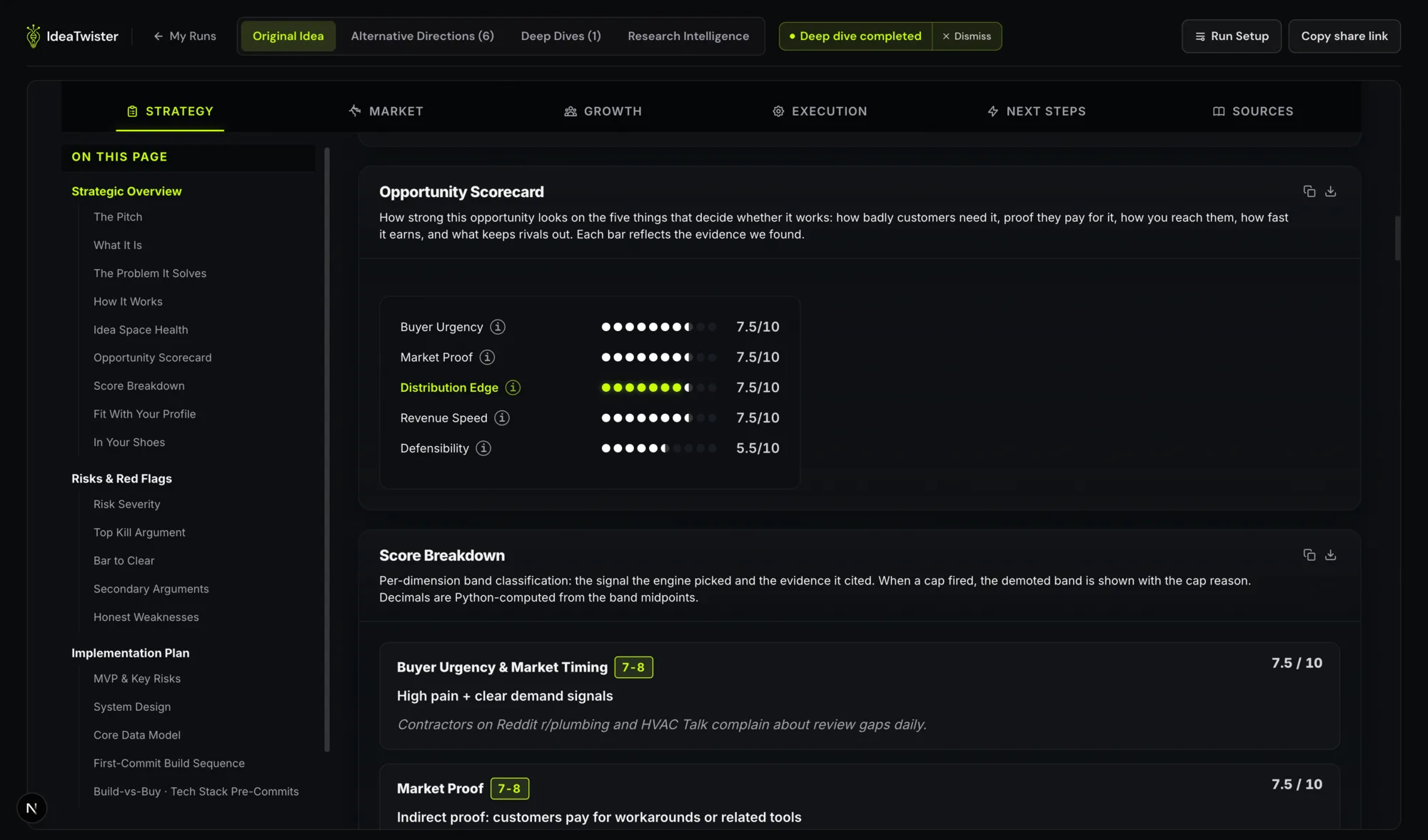
- A calibrated founder product fit score calculator evaluating five core dimensions: Buyer Urgency, Market Proof, Distribution Edge, Revenue Speed, and Defensibility.
- A Weaknesses section on every idea that names exactly where it is fragile.
- Top picks ship with GTM sketches and 30-day validation plans your non-technical co-founder owns.
- One HTML file. No login. No SaaS. Open it in a browser, send it as an attachment.
You can build the system.
First, pressure-test the idea.
These are the patterns CTOs and technical co-founders write about after the company ends. Catching them in the first week is cheap. Catching them in year two is not, and the patterns are predictable enough that they have a name.
You signed up for the relationship, not the wedge.
You agreed to build it because the relationship was right, not because the idea was pressure-tested. Six months in, you discover the wedge does not hold. The conversation you should have had on day one was the one nobody had time for.
65% of co-founder breakups are about direction.
Noam Wasserman tracked 10,000 founders. Disagreement on which opportunity of the idea to pursue is the single largest predictor of co-founder breakup. The fix is not better people. It is a shared scored artifact you both look at instead of vibes you both pitch.
You are spec'ing architecture before the buyer.
Technical co-founders default to system design when the question is still "who pays for this and why now." A scored opportunity matrix forces the buyer conversation upstream of the architecture review.
Every undiscovered opportunity is engineering work.
You can refactor the codebase. You cannot refactor 6 months. Surfacing pricing, audience, and unbundling alternatives before the first commit is cheaper than refactoring after the first 100 customers.
Tone
Always agreeable
Brutally honest. It argues the other side first.
Depth
Single conversation
30+ AI agents, every claim backed by a source
Analysis
Surface-level tips
Opportunities ranked and scored for your goal and budget
Output
Text response
Interactive workspace you can filter and share
Speed
Hours of back-and-forth
20-minute one-pass verdict
Personalised
Generic advice
Scored against your goal, budget, and weekly hours
Cost vs depth
Free, shallow. Or $5k+ consultants.
$29 to $799 per run. AI infra included.
The conversation you should have had at kickoff is the one IdeaTwister gives you in in minutes, from $9.
See the shared artifactA pressure-test before the
first PR.
Most technical co-founders skip pressure-testing because the alternatives are expensive (a strategist) or vague (a chatbot that agrees with the pitch). IdeaTwister sits between the kickoff and the first sprint.
A Devil's Advocate scores the original. A swarm of agents pulls it apart from 15+ angles. 25 ranked opportunities, every one with a Weaknesses section that names exactly where it is fragile.
Each angle runs in parallel, not one by one, and is purpose-built to surface an opportunity you might never explore on your own. The result: systematic coverage across pricing, market position, distribution and more, in a fraction of the time.
The highest-scoring opportunities surface as top picks in your report.
Why our runs finish in minutes, not hours.
IdeaTwister is not a chat window calling one model. It is an engine that fires 30+ specialized agents the moment you hit start, all running side by side. Strategy agents scout nearby markets, one writes each opportunity, a Devil's Advocate stress-tests every claim, a deep-research pass builds a 13-section report on every top pick, and an action-plan writer maps out the next 30 days. They run side by side, not one after another. What would take a human consultant weeks, or a back-and-forth chat four hours, our engine finishes in minutes.
Get the second opinion
most founders never get.
Not from friends. Not from ChatGPT prompts. From a structured founder due-diligence engine built to find weak spots, hidden risks, and better paths. Your original idea stays in the race, but it has to beat stronger nearby directions before you commit months to it. You get a verdict, the evidence behind it, and the reasons to pursue, pivot, or kill it.
 Click to play
Original idea, fully validated
Your idea gets a complete validation pass with the full analysis.
Scored on 5 dimensions
Buyer urgency, market proof, distribution edge, revenue speed, and defensibility.
Honest weaknesses
A stress-test names the strongest argument against it and where it is fragile.
Alternative directions
Not sold on the original? Alternative directions, each ranked and scored.
Research intelligence
Real market research, competitors, and sources you can open and check.
Four analysis sections
Strategy, market, launch kit, and sources, all in one place.
Original idea, fully validated
Your idea gets a complete validation pass with the full analysis.
Scored on 5 dimensions
Buyer urgency, market proof, distribution edge, revenue speed, and defensibility.
Honest weaknesses
A stress-test names the strongest argument against it and where it is fragile.
Alternative directions
Not sold on the original? Alternative directions, each ranked and scored.
Research intelligence
Real market research, competitors, and sources you can open and check.
Four analysis sections
Strategy, market, launch kit, and sources, all in one place.
Preview the decision before you pay.
Real Twists we already ran. Pick the one closest to your idea, we email you the full workspace. Same engine, $0.
Take one home for $0
A complete Twist someone else paid for. Same engine, same workspace, same scoring. Yours to keep, while it's on the shelf.
- The full interactive workspace, emailed
- Every direction scored on 5 dimensions
- Weaknesses surfaced for every variant
- Yours to keep. No card, no subscription.
from $9 per run
vs a quarter on the wrong wedge.
You will spend more on engineering tools this month. One run, one shared HTML report, one honest conversation with your co-founder before the first PR.
Re-run it every time the team considers an opportunity.
The next time your co-founder pitches an idea over coffee, run IdeaTwister before the first sprint. From $9 per run. A shared verdict, on your laptop, before the first PR.